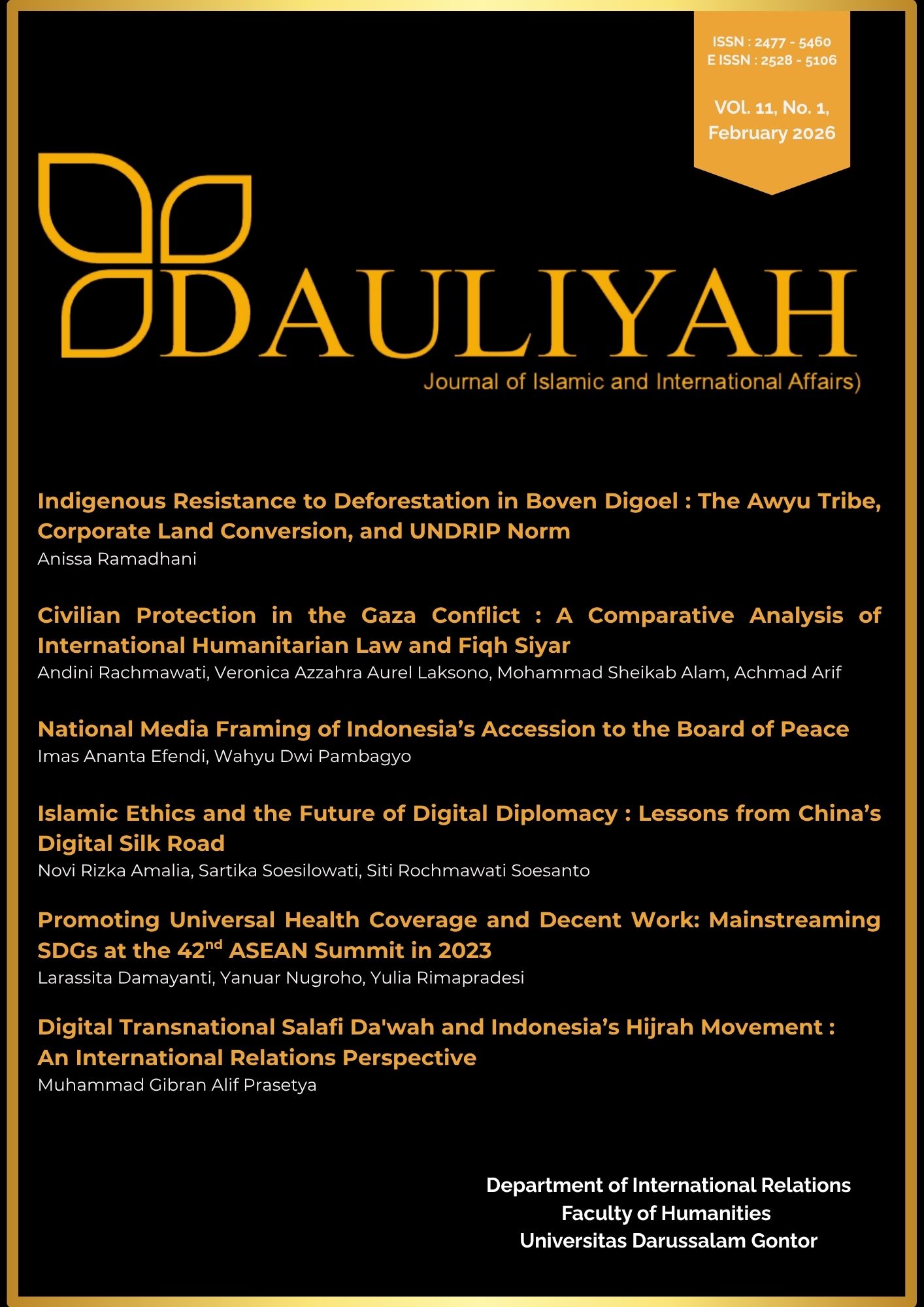
Islamic Ethics and the Future of Digital Diplomacy: Lessons from China’s Digital Silk Road
DOI:
https://doi.org/10.21111/dauliyah.v11i2.1Keywords:
China, Digital Diplomacy, Digital Silk Road, Islamic Ethics, Soft PowerAbstract
The evolution of global diplomacy into the digital sphere presents both unprecedented opportunities and profound ethical challenges. China's Digital Silk Road (DSR), as part of its broader Belt and Road Initiative, has become a significant instrument of soft power projection, particularly in the Muslim-majority regions of Southeast Asia. While the DSR emphasises connectivity and technological advancement, it also raises questions related to justice, sovereignty, surveillance, and digital control. This paper seeks to examine these developments through the lens of Islamic ethics, emphasising principles such as adl (justice), shura (consultation), karamah al-insaniyyah (human dignity), and amanah (trust). By critically engaging with China's digital diplomacy strategy, this study argues that Islamic ethical thought offers a robust normative framework capable of guiding more just, transparent, and humane approaches to digital international engagement. In doing so, the paper contributes to the development of an Islamic discourse on digital diplomacy, positioning Islamic ethics as a vital foundation for shaping the future of the global digital order.
References
Abdurrahman, T. (2006). The spirit of modernity. Casablanca: Arab Cultural Center.
Al-Ghazālī. (1998). Iḥyā’ ‘ulūm al-dīn [The revival of the religious sciences] (N. A.Faris,Trans.) Beirut: Dar al-Kotob al-Ilmiyah.
Bjola, C., & Holmes, M. (2015). Digital diplomacy: Theory and practice. New York, NY: Routledge.
Creemers, R. (2017). China’s vision for cyber sovereignty. In Policy briefs on cyber governance.
Harding, B. (2019, February 15). China’s Digital Silk Road and Southeast Asia. Retrieved July 23, 2025, from https://www.csis.org/analysis/chinas-digital-silk-road-and-southeast-asia
Ibn Khaldūn. (2005). The Muqaddimah: An introduction to history (F. Rosenthal, Trans.). Princeton, NJ: Princeton University Press.
Kamali, M. H. (2018). Ethics and fiqh for technology use in Islam. Islam and Civilisational Renewal, 9(1), 1–22.
Lim, M. (2020). The politics of digital infrastructure in Southeast Asia. Journal of Contemporary Asia, 50(5), 641–657.
Manor, I. (2019). The digitalization of public diplomacy. Cham: Palgrave Macmillan.
Nasr, S. H. (1968). Science and civilization in Islam. Cambridge, MA: Harvard University Press.
Nye, J. S. (2004). Soft power: The means to success in world politics. New York, NY: PublicAffairs.
Pantucci, R., & Lain, S. (2022, March). China’s Digital Silk Road: Strategic implications for Southeast Asia. The Diplomat.
Polyakova, A., & Meserole, C. (2019, August). Exporting digital authoritarianism. Washington, DC: Brookings Institution.
Sacks, S. (2020, July). China’s cyber sovereignty and global norms. Council on Foreign Relations.
Segal, A. (2020). The hacked world order: How nations fight, trade, maneuver, and manipulate in the digital age. New York, NY: PublicAffairs.
Sharma, R. (2021, January). The rise of the Digital Silk Road. Foreign Affairs.
Unbound, A. (2021, June 10). The Digital Silk Road and China’s technology influence in Southeast Asia. Retrieved July 23, 2025,from https://www.cfr.org/blog/digital-silk-road-and-chinas-technology-influence-southeast-asia
Wang, Z. (2023, November 25). China’s Digital Silk Road (DSR) in Southeast Asia: Progress and challenges. Retrieved July 23, 2025, from https://www.iseas.edu.sg/articles-commentaries/iseas-perspective/2024-1-chinas-digital-silk-road-dsr-in-southeast-asia-progress-and-challenges-by-wang-zheng/
Yanqi, H. (2023, August 28). China and ASEAN embrace new era of digitalization. The Jakarta Post. Retrieved July 23, 2025, from https://www.thejakartapost.com/opinion/2023/08/28/china-and-asean-embrace-new-era-of-digitalization.html
Downloads
Submitted
Accepted
Published
How to Cite
Issue
Section
License
Copyright (c) 2026 Novi Rizka Amalia, Sartika Soesilowati, Siti Rochmawati Soesanto

This work is licensed under a Creative Commons Attribution-NonCommercial-ShareAlike 4.0 International License.