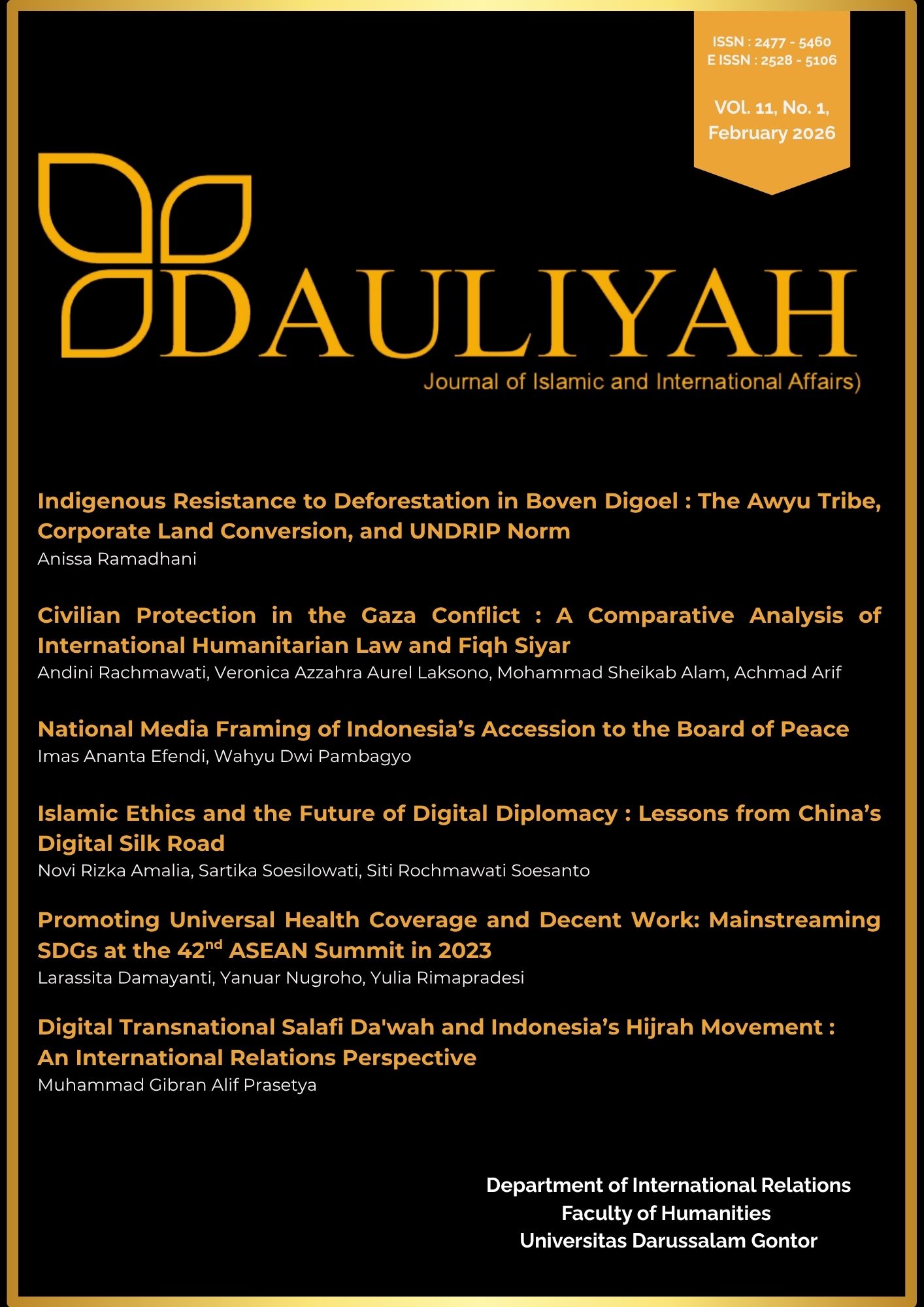
Digital Transnational Salafi Da'wah and Indonesia’s Hijrah Movement: An International Relations Perspective
DOI:
https://doi.org/10.21111/dauliyah.v11i1.12Keywords:
Digital Public Diplomacy, Hijrah Movement, Salafi Da'wah, Social Media Transnationalism.Abstract
The phenomenon of the Hijrah movement among the Indonesian Muslim middle class marks a shift in religious authority towards transnational Salafism which is massively facilitated by digital technology. This study aims to analyze the strategic role of social media in facilitating da'wah transnationalism and measure its determinants of migration decisions in the perspective of International Relations. This study applies a mixed-methods design with a concurrent embedded strategy. Data was collected through an online survey of 100 respondents participating in the Hijrah movement and digital content analysis. Quantitative analysis used Multiple Linear Regression to test the influence of access duration, frequency of interaction, and content preferences, while qualitative data was used to validate ideological narratives. The results of the study showed that social media activities had a significant positive influence on the decision to emigrate with a determination coefficient of 66.5%. Specifically, the frequency of participatory interaction and exposure to transnational ideological narratives were the strongest predictors, outperforming demographic factors. This study concludes that social media functions effectively as an instrument of "digital public diplomacy" for non-state actors in diffusing the norm of "Global Solidarity of Ummah" that transcends the boundaries of nation-states. These findings provide theoretical contributions regarding the digital soft power mechanisms of non-state actors and practical implications for policymakers in formulating critical digital literacy strategies to maintain the stability of national integration.
References
Afandi, M. R., Rizqullah, M. N., & Arifin, J. (2025). Mediated orthodoxy: Salafi thought and student piety at Sriwijaya University. Geuthèë Journal: Multidisciplinary Research, 8(3), 163–169. doi:10.52626/jg.v8i3.449
Akmaliah, W. (2020). The demise of moderate Islam: New media, contestation, and reclaiming religious authorities. Indonesian Journal of Islam and Muslim Societies, 10(1), 1–24. doi:10.18326/ijims.v10i1.1-24
Alam, L. (2025). Digital religion: Social media and the spread of Salafi thought in Indonesia. Fikrah: Journal of Aqidah Science and Religious Studies, 13(1), 21–42. doi:10.21043/fikrah.v13i1.30930
Ananda, R., Khamdan, M., & Fata, A. (2024). Salafism in Indonesia: Identity and ideological contestation in Indonesia. Al-Ittihad Journal of Islamic Thought and Law, 10(2), 16–33. doi:10.61817/ittihad.v10i2.210
Anggraeni, B. A., Malik, I., Arbiansyah, T. P. T., Setiawibawa, R., & Uksan, A. (2025). National Islam vs. transnational Islam: The war of interpretation and its impact in Indonesia. International Journal of Education, Vocational and Social Science, 4(4), 469–478. doi:10.63922/ijevss.v4i04.2404
Beta, A. (2019). Commerce, piety and politics: Indonesian young Muslim women’s groups as religious influencers. New Media & Society, 21(10), 2140–2159. doi:10.1177/1461444819838774
Billah, R., Zamzami, M., Hegazy, W., & Lutfi, M. (2025). Framing religious pluralism as deviation: A digital hadith-based discourse of Salafism on Instagram. Esensia: Jurnal Ilmu-Ilmu Ushuluddin, 26(1), 27–43. doi:10.14421/esensia.v26i1.6304
Hasan, N. (2018). Salafism in Indonesia: Transnational Islam, violent activism, and cultural resistance. In Routledge handbook of contemporary Indonesia (pp. xx–xx). Routledge.
Maharani, M. (2025). Salafism in Indonesia: Ideology, identity, and politics. Islamic Thought Review, 3(1), 1–13. doi:10.30983/itr.v3i1.9352
Masni, M. (2025). The flourishing of Indonesian conspicuous consumption in the digital world and its effects on the evolution of hijrah movements. Journal of Religious Sociology, 19, 1–14. doi:10.14421/jsa.2025.191-01
Muary, R., Susanti, N., & Atikah, P. (2025). Salafis and social media: The emergence of Islamic populism in Indonesia. Scientific Journal of Sociology of Religion and Social Change, 18, xx–xx.
Nisa, E. (2017). Creative and lucrative daʿwa: The visual culture of Instagram amongst female Muslim youth in Indonesia. Asiascape: Digital Asia, 5(1–2), xx–xx. doi:10.1163/22142312-12340085
Raihan, M. (2025). Mapping the transnational network of religious ideology among Islamic education students. AN-NUR: Journal of Education and Learning, 1(2), 197–210. doi:10.65802/an-nur.v1i2.45
Siregar, E., Tullaili, M., & Afdal, Z. (2025). Social media on Islamic lifestyle trends: A systematic literature review. Indonesian Interdisciplinary Journal of Sharia Economics, 8(1), xx–xx. doi:10.31538/iijse.v8i1.6167
Wildan, M., Pratama, I. A., & Sugiarto, D. (2025). Gen Z Muslims, social contestation, and digital citizenship in Indonesia. Tribakti: Journal of Islamic Thought, 36(1), 165–182. doi:10.33367/tribakti.v36i1.6421
Downloads
Submitted
Accepted
Published
How to Cite
Issue
Section
License
Copyright (c) 2026 Muhammad Gibran Alif Prasetya

This work is licensed under a Creative Commons Attribution-NonCommercial-ShareAlike 4.0 International License.